From day one, or somewhere in between.
Some children are born with conditions that affect movement from day one. Others develop typically until something interrupts it, an injury, a delayed milestone, a movement disorder that emerges with age.
Cerebron’s paediatric rehabilitation programme is built for children whose movement, posture, or development isn’t where it should be, and for the parents who’ve been told to ‘wait and see’ when waiting isn’t an answer.

Child-specialised
Play-based therapy

The child plays. We measure the therapy.
Paediatric rehabilitation is physical and developmental therapy for children whose growth, movement, or motor skills need professional intervention, usually from infancy through adolescence.
Some children are born with conditions that affect movement from day one. Others develop typically until something interrupts it, an injury, a delayed milestone, a movement disorder that emerges with age.
With the right intervention, at the right age, in the right setting, children can develop skills that without therapy would not have come.
A child won’t ‘do their exercises’ the way an adult will. So the therapy has to feel like play, but be designed with the seriousness of clinical work. That’s our balance.
Every activity targets a specific motor skill, balance system, or functional goal, but the child sees a game. Engagement is part of the therapy.
Recovery is hard. Regret is harder.
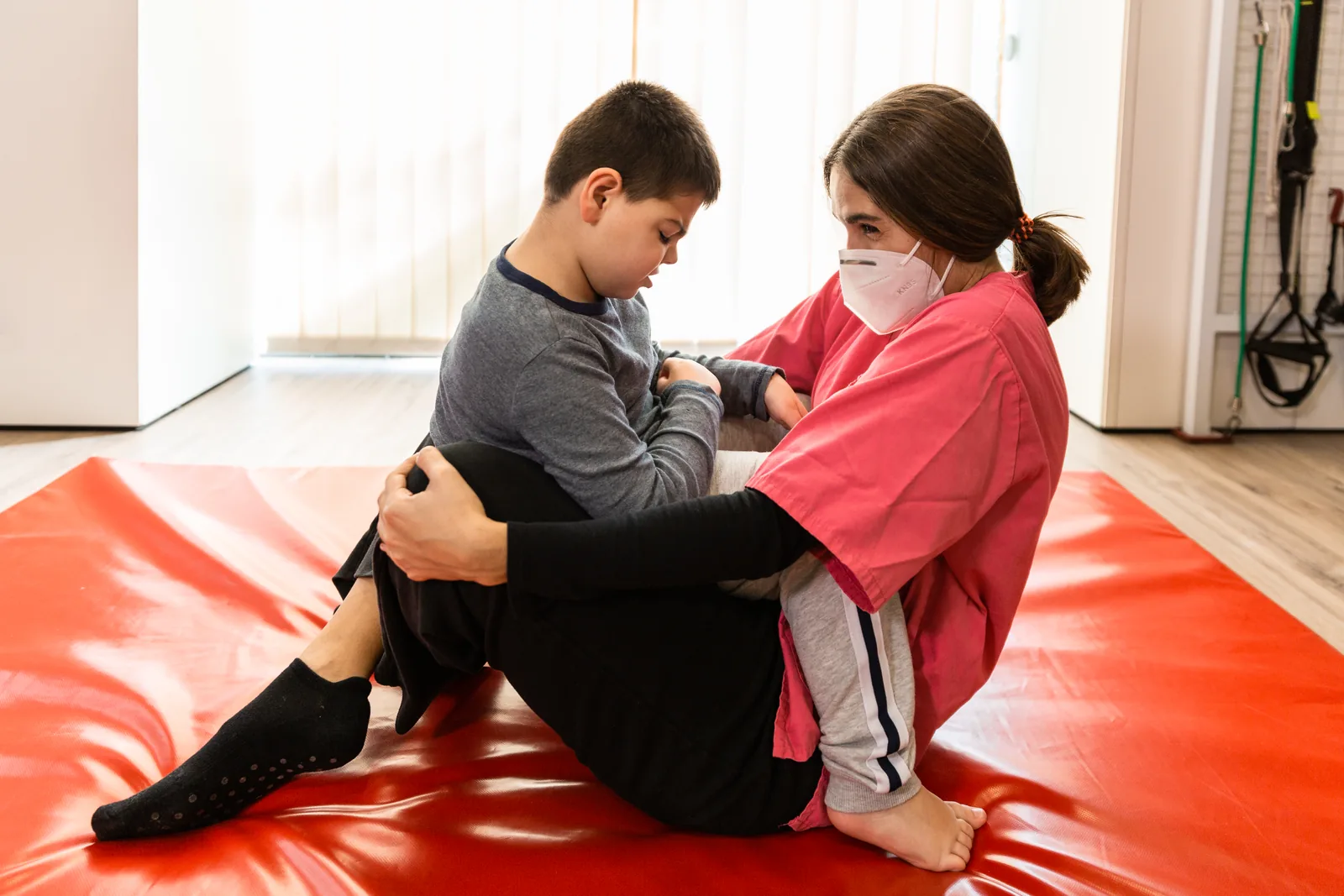
A child is not a small adult. Their therapy can't be a smaller version of adult rehab.
Every session is designed around tasks the child sees as games, but each game is engineered to target a specific motor skill, balance system, or functional goal. The child plays. We measure the therapy.
Children spend more time with parents than therapists. We train you in what to reinforce at home, what to avoid, and what to watch for, so progress continues between visits.
Some conditions can be substantially improved. Some can only be optimised within their natural ceiling. We tell you which is which at the first visit, without sales-speak, without false hope, without dismissing what's possible.
We coordinate with paediatricians, neurologists, and speech therapists where relevant. A child's development is rarely a one-discipline problem. We don't pretend otherwise.
A note on standards
If we’re not the right fit for your child’s needs, we’ll tell you, and point you to who is. The plan should serve the child, never the other way around.
Book a paediatric assessmentEvery child is assessed individually. Every plan is built around that one child, not the diagnosis label.
Movement, posture, and functional skill development across all CP types.
Children not meeting milestones for sitting, crawling, walking, or balance.
Coordination disorders, dyspraxia, and motor planning challenges.
Muscular dystrophy and related neuromuscular conditions in childhood.
Recovery after paediatric fractures, surgeries, or accidents.
Infant neck and head-shape issues, ideally caught early.
Used selectively, age-appropriately, and only where it adds something hands-on therapy alone can’t.
Children love it, light-based games that are genuinely fun. Used for reaction speed, coordination, and bilateral motor planning. Particularly effective for CP and dyspraxia.
Game-based balance training that turns balance work into screen-time the child looks forward to. Quantifies progress in a way both child and parent can see.
For paediatric cases with significant hand and finger impairment, CP with hand involvement, post-injury hand weakness. Used selectively, in age-appropriate sessions, and only with appropriate assessment.
Each technology has its own dedicated page, explore our technology →
Family-inclusive, child-paced, and reviewed every four weeks.



If yours isn’t here, send a message, Dr. Shikha’s team replies personally, usually within one working day.
Not always. 'Wait and see' is appropriate for some early milestones; it's wrong for others. If you've noticed something consistent, your child isn't sitting, crawling, walking, or using both hands the way other children their age do, an assessment loses nothing and may catch something early. Early intervention almost always outperforms late.
Honest answer: it depends on the type and severity of CP, and the child's age at intervention. For many children, structured paediatric rehab significantly improves function, posture, and independence, particularly when started young. We'll give you a realistic, specific assessment at the first visit, not a generic answer.
Children don't hate movement, they hate boring, repetitive movement that feels like punishment. Our sessions are designed around play. Most children come back enjoying it. If your child doesn't engage in the first few sessions, we redesign the approach. That's our job, not yours.
Yes. We encourage it, especially in the first weeks. Children respond better when both parents are aligned on what's being worked on. Schedule permitting, both parents in the room is welcome.
We coordinate with paediatric neurologists, speech therapists, occupational therapists, and special educators where relevant. We don't do those disciplines ourselves, but we work closely with families and other specialists to make sure the child's overall care is integrated.
Recovery is hard. Regret is harder.
Book a paediatric assessment with Dr. Shikha. Or send us a quick message on WhatsApp, she personally responds within one working day.
Therapy that feels like play. Built like clinical work.