Post-Stroke Recovery
Retrains the affected side. Reaction drills rebuild upper-limb speed, scanning, and bilateral coordination.
BlazePod is a reactive light-pod system that retrains reaction time, decision-making, and coordinated movement under load, the brain-body link that ordinary exercise rarely touches. We use it across neurological, paediatric, geriatric, and sports rehabilitation.
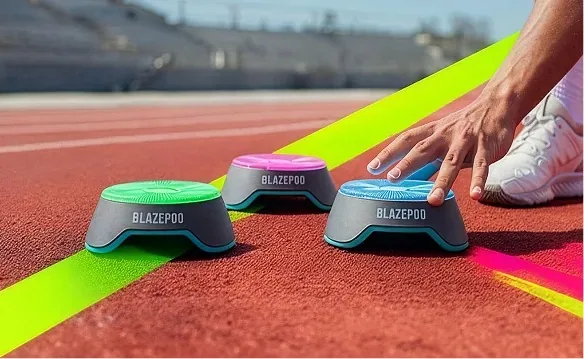
BlazePod is a set of programmable light pods controlled from a tablet. A pod lights up, the patient hits it, taps it, steps on it, reaches for it, and the system measures how fast and how accurately they responded.
Underneath the simple interaction is the actual mechanism of recovery: visual scanning, decision-making, motor planning, and coordinated movement, all under timed load. That is the brain-body link, and that is what most rehabilitation programmes underdose.
Used correctly, by a therapist who knows how to scale it, BlazePod becomes one of the most direct ways to train the reactive capacity that real life demands.
Four steps. The hardware is simple, the therapy around it is where recovery happens.
A coloured light fires. The brain detects, decides, the body responds, measured to the millisecond.
Pods change colour, sequence, and timing, scaled from simple touch drills to dual-task work.
Reaction time, accuracy, asymmetry, captured automatically and compared session over session.
It feels like a game. Patients push harder, stay longer, repeat more, the engine of motor learning.
Different populations, same underlying mechanism, reaction trained under load, carried into real life.
Retrains the affected side. Reaction drills rebuild upper-limb speed, scanning, and bilateral coordination.
A near-miss is a reaction-time problem. Pods train the recovery step that prevents the fall, directly, measurably.
Builds cognitive-motor pathways through play. Children stay engaged long enough for real motor learning to happen.
Targets motor planning and processing speed, two of the most disrupted faculties after traumatic brain injury.
Return-to-play decisions need data. Reaction time, agility, and sport-specific drills measured before clearance.
Visual scanning, head turns, and reactive stepping retrained together, the way balance actually fails in daily life.
Built into your wider programme, never bolted on. Numbers tracked, progress visible.
If yours isn't here, send a message, Dr. Shikha's team replies personally, usually within one working day.
Recovery is hard. Regret is harder.
Book an assessment with Dr. Shikha. She'll evaluate the patient personally, decide whether reactive training is the right fit, and build it into a plan that makes measurable sense.