Post-Stroke Hand Recovery
Hemiparesis affecting fingers, grip and fine motor control after ischemic or hemorrhagic stroke.
Cerebron's Robotic Gloves guide weakened fingers through patterns of movement the patient can't yet make alone, letting the hand do the work while the brain re-learns how to control it.
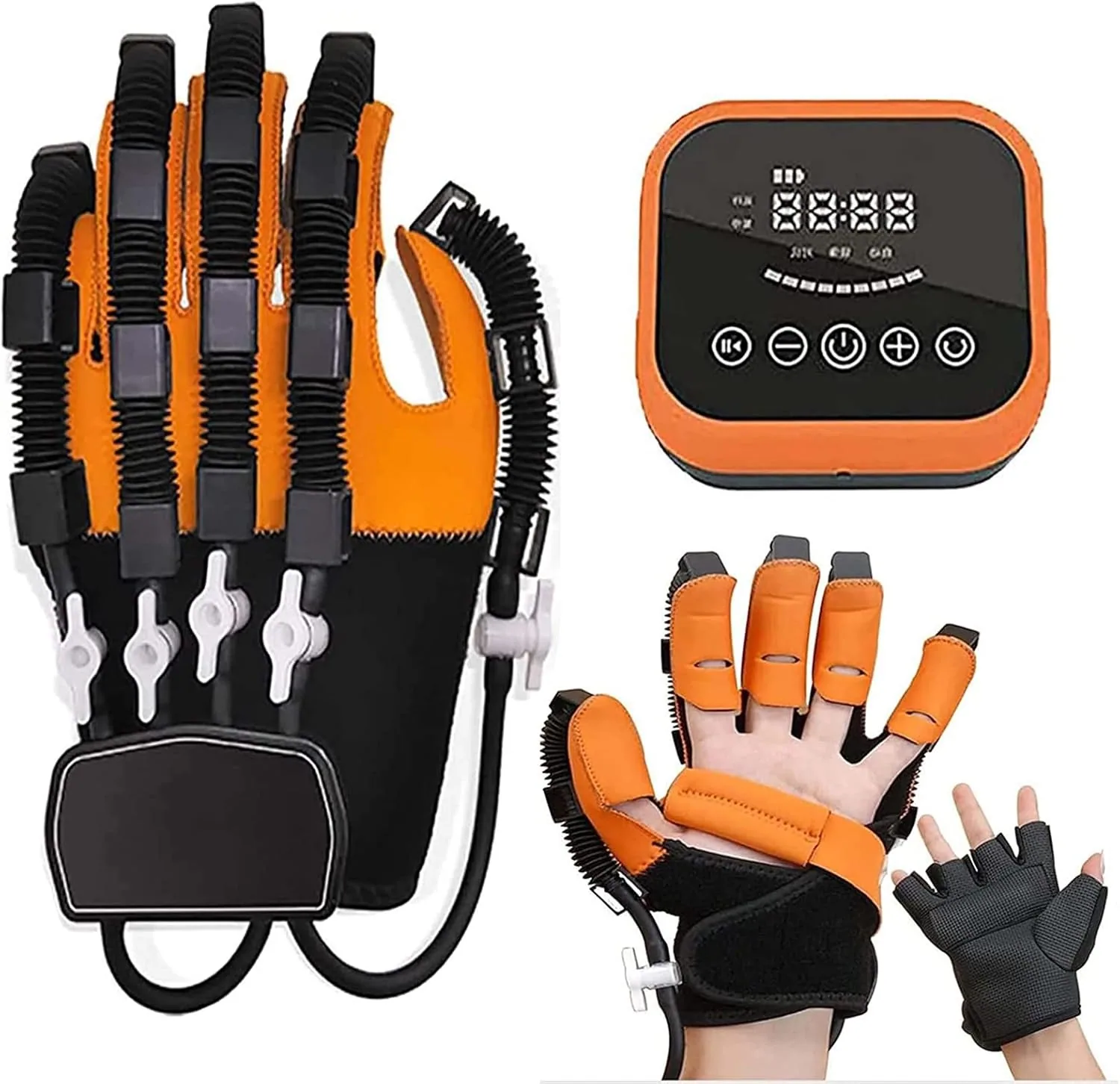
A robotic glove is a wearable rehabilitation device fitted over the patient's hand and forearm. Embedded sensors track finger position; small motors apply gentle, controlled force to guide each finger through specific movement patterns, gripping, releasing, pinching, extending, that the patient is unable to perform on their own.
It is the most concentrated form of hand rehabilitation available outside a research lab. Where a therapist's hands can guide a few hundred finger repetitions per session, a robotic glove can deliver thousands, accurately, consistently, and tracked in real time.
Hand recovery is uniquely difficult. The hand has more fine motor neurons mapped to it than almost any other part of the body, which means it takes more repetition, over more weeks, to rebuild after a stroke or neurological injury. Robotic Gloves change the maths of that rebuild.
Used as part of a wider therapy plan, never alone, they're one of the most evidence-supported interventions in modern neuro-rehabilitation.
Four principles do the heavy lifting. None of them are magic, all of them are well-documented neuroscience.
After a stroke or neurological injury, the brain learns through practice, hundreds, often thousands, of correct movements per session, far beyond what manual therapy alone can deliver.
Bad movement repeated thousands of times teaches bad movement. The glove guides each finger through the exact correct path, so the brain re-learns the right pattern, not a compensated version.
The glove never moves a passive hand. The patient is actively trying; the glove assists what the hand can almost do. Intention plus guided motion is what drives neuroplasticity.
Every session logs grip strength, range of motion and movement quality. Progress is visible, week by week, for the patient, the family, and Dr. Shikha to plan against.
Not everyone with hand weakness benefits equally. These are the patients where the evidence is strongest.
Hemiparesis affecting fingers, grip and fine motor control after ischemic or hemorrhagic stroke.
Incomplete SCI patients with preserved nerve pathway potential in the hand.
TBI patients with upper-limb motor impairment, typically as part of a wider rehab plan.
Children with hemiplegic CP affecting hand function, used in age-appropriate sessions.
Hand-surgery patients struggling to regain controlled finger movement.
Selected nerve-injury patients with potential for re-innervation.
Built into your wider programme, never bolted on. Numbers tracked, progress visible.
If yours isn't here, send a message, Dr. Shikha's team replies personally, usually within one working day.
Recovery is hard. Regret is harder.
Book an initial assessment with Dr. Shikha. She'll evaluate the hand directly and tell you honestly whether the glove is likely to help, and what alternatives exist if it isn't.